Enjoyment
Tantra style
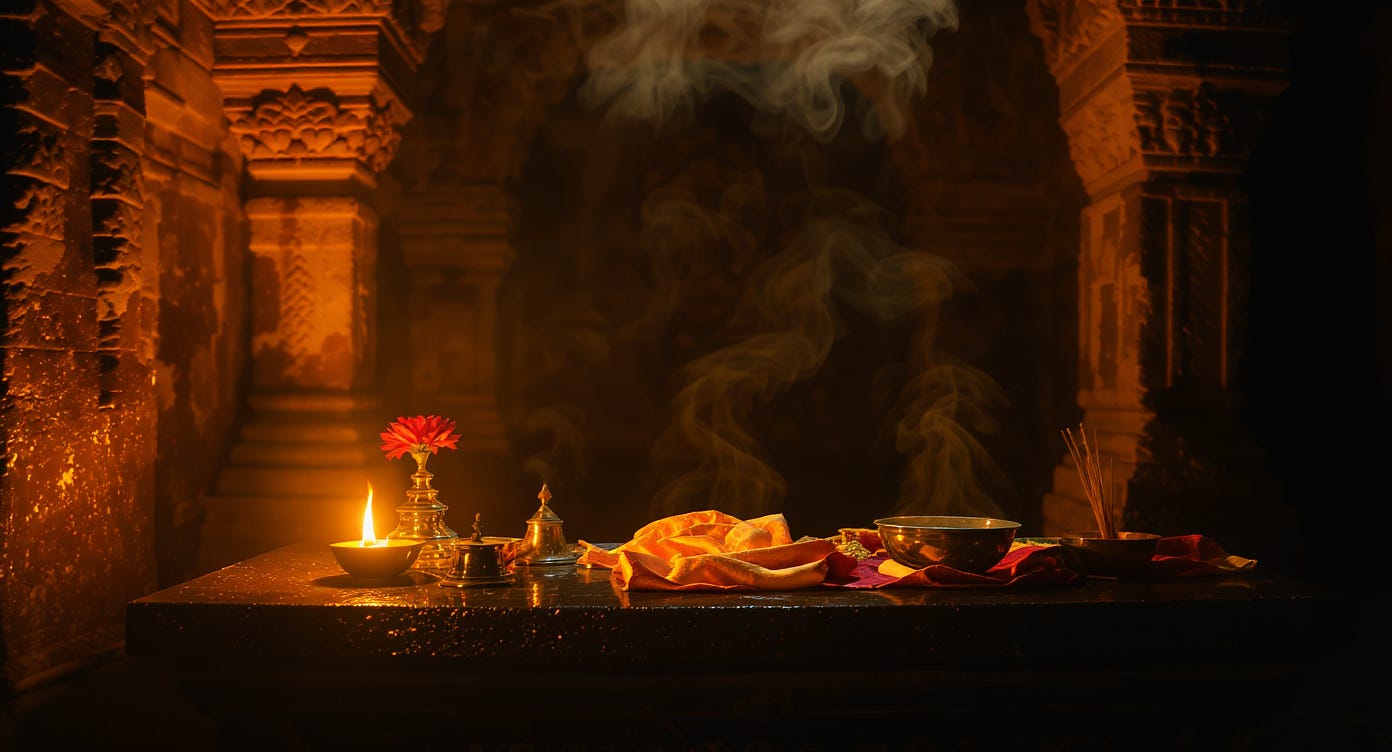
In a recent trip to India I had the honour of participating in a contemporary reconstruction of a 1000-year old ritual called the Trika Pūjā. Trika means “triad” and Pūjā means “worship.” This ritual is about the worship of three goddesses, who together form the holy trinity of Tantric religious practice.1
I was in an underground temple amongst the tea plantations of Kerala in southern India. I was with my beautiful wife and a small group of young Indians who are Tantric practitioners.
This ritual, the Trika Pūjā, had essentially been lost until the scholarly work of Mark Dyczkowski. Markji, as he is affectionately known by these people, was a man who spent his life in India working to recapture the Tantric traditions. He passed away in early 2025 and so the enactment of this ritual in contemporary settings is, to some extent, a way to honour his legacy. Markji’s work has allowed practitioners to reconstruct the medieval style of worship of these three goddesses.
And so we were treated to the ritual. The liturgy was read by a Sanskrit scholar named Sachin who had come down especially from Kashmir. It was enacted by a yoginī, that is, a woman who has been initiated into the tradition.
The ceremony peaked with the offering of sacrifices to the five senses. I found this really striking, both symbolically and personally. This highlights something profound about Tantrism as a spiritual and religious practice.
In this tradition the point of religious devotion, of heightened spiritual awareness, is not otherworldly. It is not in a “somewhere else.” It is not in a “beyond.” It is right here, all the time, brought to you by sight, hearing, touch, taste and scent.
Downwards
In my last post I described this tradition’s sense of the “beyond,” of the “somewhere else.” This is the upward path, away from the body and its senses and towards an experience of ultimate reality in which a person is able to experience something tremendous and otherwise inaccessible, namely, the experience on monism, where everything collapses into just one thing.
I think that this is the kind of spirituality most people are comfortable with. The great spiritual heroes are often depicted as monks and nuns in solitude, on mountaintops and in caves, shunning the world and its pleasures, rejecting the body and its needs, pursuing these kinds of deep insights, insights that are beyond words and well out of the range of ordinary daily experience.
The Tantrikas of the Trika tradition call this the path of liberation, the way of moksha. A person on this path even had a title. They were a mumuskhu.
This path is also the path of the renouncer, of renunciation. Usually we think of this as the hardest path - to walk away from the world and pursue insight instead. But for them this was sometimes thought about as the easy path. Initiation as a mumukshu was relatively straightforward and relatively quick.
The other spiritual path is the way of bhoga. This is the path of enjoyment. A person on this path also had a designation. They were called a bubhukshu.
This is the downward trajectory, away from the ultimate, disembodied, un-selfed and undifferentiated union of peak insight. This is the journey down into the self, into the ego and, ultimately, into the body and its five senses.
It is a little difficult for us to understand that this journey into the senses, into the body and all of its pleasures, was sometimes talked about as the difficult path. Initiation into this path was demanding, rigorous, time consuming and required great sacrifice.
This is the way of the householder, of the ordinary person pursuing spirituality, who does not renounce the world but instead, wholly embraces it.
The tradition that I am most interested in is a kind of stream within the Trika school, called the Kaula lineage. For a Kaula, these two are not alternatives. Both are considered essential. They are, in the end, just two sides of the same thing. They interpenetrate each other, you can’t have one without the other.
You are asked, therefore, to do both things, simultaneously - the pursuit of direct insight of a pure indescribable character. And you are asked to realise the fruits of this sublime experience in the cut and thrust of ordinary life. You are asked to bring the most profound mystical experience that you can imagine to bear on the moments of ecstasy, of boredom, of love and of hatred, that constitute a day-in-the-life.
At long last, Tantric sex
Now, I’m going to do something in this post that I have studiously avoided in over two years of public writing about Tantra. But maybe it is time to talk, just a little, about Tantric sex. It makes, sense, I guess, to place that in a post about “enjoyment.”
There are basically two camps on this topic and I belong to neither of them. There is the camp of classical Tantra. These are people who focus on the spiritual practices and religious texts from the authentic Indian traditions. And then there are the neo-tantrics, people who operate within the new age alternative spiritual movements. They tend to see the Tantric emphasis on enjoyment and pleasure as a way to reclaim a shameless and effortless enjoyment of the human body, especially as experienced in sex.
Ne’er the twain shall meet. The classical tantrics think the neo-tantrics are apostates, appropriating and distorting a beautiful and venerable tradition to pursue hedonistic sexual desires because of a Western cultural obsession with sex. And the neotantrics see the classical tantrics as prudish and conservative, disconnected from the living experience that their teachers are pointing towards.
To explain my position on this, let me take you back to that Trika Pūjā. The climax of the ceremony, as I have said, was to offer sacrifice - to worship - the five senses.
Back to Your Senses
The reasons for this are profound and I will not be able to explain it in full here. But I will just say this, and it is very hard for people raised in post-Judeo-Christian cultures to fully grasp what I am about to say. For the ancient and medieval Tantrikas, consciousness and its capacity for self-awareness were divinity in and of itself. There is no concept of god here that is separate from the consciousness that you experience every day as a conscious being. Any conscious experience is, by definition, direct experience of the divine.
And it is a simple fact of human experience that sensory experiences are processed, by an large, by consciousness. It is quite difficult to understand what it would mean to talk about a human consciousness in the complete absence of sensory experience. The moment a smell, a sight, a sound, a sensation, a taste arises in consciousness, consciousness itself becomes apparent, vivid. And so … to have a peak experience of the divine is to have a peak experience of consciousness is to have a peak experience of the senses. That is Tantrism in a nutshell.
I asked my Indian friends about this problem, the problem of Tantric sex. One of the things they said was along these lines: if worship means honouring the five senses, then there are only a few things that the human being can do that consume, immerse, hijack, and intensify all five senses at once. And one of them is sex.
And so, for this reason amongst many others, sex does hold a particularly sacred place in Tantric spiritual practice, and both the neotantrics and the classical tantrics can, I think, at least agree on this. It has the capacity to produce in a person’s consciousness an especially heightened sensory experience. And this, for the well trained Tantrika, is by definition an especially heightened and intense experience of divinity itself.2
The Tantric challenge, however, is not to limit the experience of the divine to such obviously intensely sensory and ecstatic experiences Tantric sex. The reason the downward path is the harder path is because you are being asked to transmute all sensory experience into an ultimate experience of divine ecstasy.
If you wanted to start down this path, you would begin with something relatively easy to divinise. Maybe it is an exquisite glass of red wine, or a perfectly cooked rump steak, or a perfect chocolate cake, or a simple but beautiful ripe raspberry.
And if you can master this, the challenge is to go even further. What about that feeling of rage or hatred or sadness? What about the boredom of doing the dishes? What about the disgust of the midnight nappy change?
Yes, even here, the Tantrikas ask you to find god…
Neil
I won’t go into the goddesses here, but they are Parā (the ultimate), Parāparā (the ultimate-non-ultimate), and Aparā (the non-ultimate).
The deeper reason has to do with deep symbolism: the ecstatic union of two equal but opposite principles (masculine and feminine) are the origin of living things, of divinely conscious things. The ground of being is here the relation between these two principles, hypostasised variously as shiva (or consciousness) and shakti (or energy). But if you want to know more about that, you’ll have to let me know…


Excellent piece! I hope a book is on it’s way.